Medieval Europe: History, Timeline & Map (c. 500–1500)
Medieval Europe from the Franks to the Black Death: Charlemagne, Vikings, universities, translations from Arabic, the Crusades and Magna Carta, on a map.
 Open the interactive map
After Rome: kingdoms, monasteries and Charlemagne
"Middle Ages" is itself a label invented by Renaissance humanists for the centuries between ancient Rome and their own revival of classical learning, and most historians now reject the older idea of a "Dark Age". In the former western provinces, Germanic-led kingdoms such as the Franks under Clovis (baptised around 496–508; the date is debated) ruled populations that kept Latin, Roman law and Christianity. Monasteries following the Rule of Benedict copied texts and managed land. Charlemagne, crowned emperor by Pope Leo III in Rome in 800, united much of western Europe for a generation.
From the late eighth century Scandinavian raiders and traders, the Vikings, reached Britain, Ireland, France, the rivers of Eastern Europe and even North America around 1000. In the east, Kyivan Rus', the shared medieval heritage of Ukraine, Belarus and Russia, adopted Orthodox Christianity from Byzantium around 988.
Growth, learning, crusade and plague
Between about 1000 and 1300 population, towns and trade grew. Universities took shape at Bologna, Paris and Oxford, and translators in Toledo and Sicily rendered Arabic works, including Avicenna's medicine and Greek philosophy transmitted through Arabic, into Latin. Gothic cathedrals rose, and in England Magna Carta (1215) set limits on royal power for the barons, though it was soon annulled and later reissued.
The same Latin Christendom launched the Crusades (1095–1291). Crusaders massacred Jewish communities in the Rhineland in 1096 and Muslim and Jewish inhabitants of Jerusalem in 1099, and the Fourth Crusade sacked Christian Constantinople in 1204. In Iberia the Christian kingdoms' expansion ended with the fall of Granada in 1492. The Black Death of 1347–1351 killed perhaps a third to a half of Europe's population, by different estimates, and was followed by massacres of Jews blamed for the plague.
Timeline of events
496 CE · Baptism of Clovis, King of the Franks
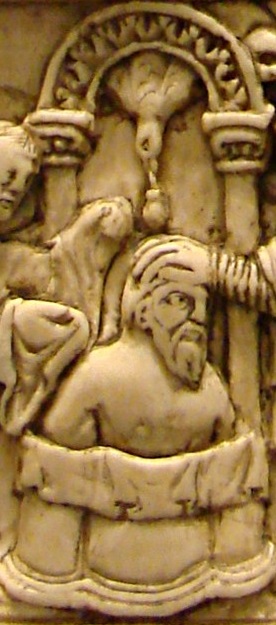
Clovis I, who had united most of the Franks and conquered much of Roman Gaul, was baptised by Bishop Remigius at Reims on a Christmas Day traditionally dated to 496 from the account of Gregory of Tours; many historians now place it later, between about 498 and 508. Unlike the Gothic, Burgundian and Vandal kings, who followed Arian Christianity, he chose the Nicene (Catholic) faith of his wife Clotilde and of the Gallo-Roman bishops. That choice won him the support of the Church in Gaul and prepared the long alliance between Frankish kings and the papacy. (Reims) View on map
529 CE · Benedict Founds Monte Cassino
By tradition in about 529, Benedict of Nursia founded a monastery on the hill of Monte Cassino, between Rome and Naples, on the site of an older pagan sanctuary. There he wrote, probably in the 530s or 540s, a Rule for monks that drew on earlier texts such as the anonymous Rule of the Master and ordered the day around prayer, manual work and reading under an abbot. Nearly all that is known of his life comes from the Dialogues of Pope Gregory the Great (c. 593); the Rule spread slowly and became the standard for monasteries in the Latin West under the Carolingians in the 9th century. (Monte Cassino) View on map
732 CE · Battle of Tours (Poitiers)
In October 732, or 733 by some reckonings, Frankish forces under Charles Martel defeated an Umayyad army led by ʿAbd al-Raḥmān al-Ghāfiqī, governor of al-Andalus, somewhere between Poitiers and Tours, as the raiders headed for the rich abbey of Saint Martin. The governor was killed and his army withdrew; Arabic sources remember the field as Balāṭ al-Shuhadāʾ, the 'Pavement of the Martyrs'. Later writers such as Edward Gibbon cast the battle as the rescue of Christian Europe, but most historians now see it as the defeat of a large raid that strengthened Charles Martel and his Carolingian heirs, while Muslim garrisons from al-Andalus held Narbonne until 759. (Between Tours and Poitiers) View on map
793 CE · Viking Raid on Lindisfarne
In 793 Scandinavian raiders sacked the monastery of Lindisfarne, a Northumbrian centre of learning founded by Aidan in 635, killing or carrying off monks and seizing its treasures; the Anglo-Saxon Chronicle gives the date as 8 January, usually emended to 8 June. Alcuin, a Northumbrian scholar then at Charlemagne's court, wrote that such a terror had never before appeared in Britain. The raid is conventionally taken as the start of the Viking Age, in which Norse raiders, traders and settlers reached from Ireland to the Volga, where they exchanged furs and slaves with merchants from the Abbasid world for silver dirhams later found in Scandinavian hoards. (Lindisfarne) View on map
800 CE · Charlemagne Crowned Emperor in Rome
On Christmas Day 800 Pope Leo III crowned Charlemagne, king of the Franks and the Lombards, as emperor in St Peter's Basilica, reviving in the West an imperial title vacant since 476. His biographer Einhard claimed Charlemagne had not known what the pope intended, a claim historians still debate, and Constantinople, then ruled by the empress Irene, did not recognise him as emperor until 812. His court at Aachen, with scholars such as Alcuin, led the revival of Latin learning known as the Carolingian Renaissance, and he exchanged embassies with the Abbasid caliph Hārūn al-Rashīd. (Old St Peter's Basilica, Rome) View on map
988 CE · Vladimir I and the Christianisation of Kyivan Rus'
Around 988 Vladimir I, prince of Kyiv, accepted baptism into Byzantine Christianity as part of a bargain with the emperor Basil II: he sent warriors to help crush a rebellion and married the emperor's sister Anna. The Primary Chronicle, compiled in Kyiv more than a century later, tells how he weighed Islam, Judaism and Latin and Greek Christianity before choosing Byzantium, and places his baptism in Byzantine Chersonesos in Crimea, though other traditions place it in or near Kyiv. The conversion of the wider population took generations; the church of Rus', headed by a metropolitan sent from Constantinople and using Slavonic texts from Bulgaria, is heritage shared by Ukrainians, Belarusians and Russians. (Kyiv) View on map
1021 CE · Norse Presence at L'Anse aux Meadows
Around the year 1000 Norse voyagers from Greenland built a small camp of turf halls and workshops at L'Anse aux Meadows on the northern tip of Newfoundland; a tree-ring and radiocarbon study published in 2021 dates wood cut there with metal tools to 1021. Excavated from 1961 by Helge Ingstad and Anne Stine Ingstad, the site was used only briefly, and butternuts found there show voyages further south, into the region that many scholars identify with the Vinland of the Icelandic sagas. The land was not empty: Indigenous peoples had used the area for thousands of years, and the sagas, written down some two centuries later, tell of trade and fighting with people the Norse called Skrælings. (L'Anse aux Meadows, Newfoundland) View on map
1088 CE · University of Bologna Takes Shape
From the late 11th century students from across Europe gathered in Bologna to study Roman law with teachers such as Irnerius (active c. 1100), who glossed Justinian's Digest; the founding date of 1088 was fixed only in 1888, by a committee led by the poet Giosuè Carducci. The students formed self-governing associations (universitates), grouped into 'nations' by origin, that hired teachers and elected rectors, and the emperor Frederick Barbarossa's Authentica Habita (c. 1155–1158) protected travelling scholars. With Paris and Oxford, Bologna became a model for Europe's universities, though other institutions of higher learning, such as the Nizamiyya madrasas of the Seljuk lands (from 1065) and Nalanda in India, were older. (Bologna) View on map
1099 CE · First Crusade Captures Jerusalem
European Crusaders capture Jerusalem after a bloody siege, establishing the Crusader States in the Levant. (Jerusalem) View on map
1130 CE · Toledo School of Translators
After Castile takes Toledo in 1085, the city becomes a meeting place of Arabic, Hebrew and Latin learning. From about 1130, under Archbishop Raymond and later with scholars such as Gerard of Cremona (d. 1187), Jewish, Arabic-speaking Christian (Mozarab) and Latin scholars translate Arabic works into Latin, from al-Khwarizmi and Ibn Sina to Arabic versions of Aristotle and Ptolemy. The work continued, with peaks and pauses, until about 1280 and fed the curricula of Europe's new universities. 'School of Translators' is a later name for this long-running activity, not a formal institution. (Toledo, Spain) View on map
1144 CE · Abbot Suger's Choir at Saint-Denis
On 11 June 1144 Abbot Suger consecrated the new east end of the royal abbey church of Saint-Denis, north of Paris, built in under four years. Its ambulatory and ring of chapels combined pointed arches, rib vaults on slender columns and wide stained-glass windows into one continuous space filled with coloured light, which Suger, in his own accounts of the work, called a 'new light'. None of these elements was new in itself, since pointed arches and rib vaults had been used in Islamic and Romanesque buildings, but their combination here is conventionally taken as the start of Gothic architecture; the upper choir was rebuilt in the 13th century, and Suger's ambulatory survives. (Basilica of Saint-Denis) View on map
1147 CE · Second Crusade
After the fall of the County of Edessa to Zengi in 1144, Pope Eugene III calls the Second Crusade. Led by Louis VII of France and Conrad III of Germany, it ends in humiliating failure at the walls of Damascus in 1148 — strengthening Muslim resolve and proving that the First Crusade's success was not easily repeatable. (Damascus, Syria) View on map
1151 CE · Hildegard of Bingen Completes Scivias
Hildegard (1098–1179), a Benedictine abbess in the Rhineland, completed Scivias ('Know the Ways'), an account of 26 visions with their interpretation, around 1151, ten years after she began it; Pope Eugene III had read part of it at the synod of Trier in 1147–1148 and encouraged her to go on. About 1150 she moved her nuns to a new convent she had founded at Rupertsberg near Bingen. She also wrote on medicine and natural history, composed some 70 liturgical songs and the sung morality play Ordo Virtutum, and corresponded with Bernard of Clairvaux, popes and emperors; the Catholic Church named her a Doctor of the Church in 2012. (Rupertsberg, Bingen) View on map
1154 CE · Al-Idrisi's World Geography for Roger II
In January 1154 the Arab geographer Muhammad al-Idrisi, born in Ceuta and educated in Córdoba, completed at Palermo a description of the known world for Roger II, the Norman king of Sicily. Known as the Book of Roger and in Arabic as Nuzhat al-mushtāq ('the journey of one who longs to cross the horizons'), it combined Ptolemy and earlier Arabic geographers with reports gathered from travellers into a text with a world map and 70 regional maps, drawn with south at the top; a silver disc engraved with a map of the world, made for the king, is lost. The work reflects the Arabic, Greek and Latin court culture of Norman Sicily, and its manuscripts were copied mainly in the Islamic world. (Palermo, Sicily) View on map
1189 CE · Third Crusade — Richard vs. Saladin
After Saladin recaptures Jerusalem in 1187, Europe launches the Third Crusade led by Richard I 'the Lionheart' of England, Philip II of France, and Frederick Barbarossa (who drowns en route). Richard wins battles at Acre and Arsuf but cannot retake Jerusalem. He and Saladin negotiate a truce granting Christian pilgrims access — a moment of grudging mutual respect between East and West. (Jerusalem / Levant) View on map
1204 CE · Fourth Crusade Sacks Constantinople
In one of history's great betrayals, the Fourth Crusade — originally aimed at Egypt — is diverted to Constantinople by Venetian commercial interests and political intrigue. Crusaders sack the Christian capital of Byzantium for three days, destroying priceless relics and libraries. The Latin Empire they install fatally weakens Byzantium, paving the way for Ottoman conquest 250 years later. (Constantinople) View on map
1215 CE · Magna Carta Signed
King John of England signs the Magna Carta, limiting royal power and establishing principles that influenced constitutional law worldwide. (Runnymede, England) View on map
1241 CE · Mongol Invasion of Poland and Hungary
After taking Kyiv in December 1240, Mongol armies under Batu and the general Subutai struck Central Europe in two prongs: on 9 April 1241 one force defeated and killed Duke Henry II of Silesia at Legnica, and on 11 April the main army destroyed the army of King Béla IV of Hungary at Mohi on the Sajó river. For a year Hungary was ravaged, its towns and villages burned and many of its people killed or enslaved, as the cleric Rogerius, himself a captive, described in his Carmen miserabile; estimates of the losses vary widely. The Mongols withdrew in 1242, and historians still debate why: news of the Great Khan Ögedei's death, a coming succession struggle, a lack of pasture, or a wet spring that turned the plain to marsh. (Mohi, Hungary) View on map
1320 CE · Dante Writes the Divine Comedy
Dante Alighieri composes the Divine Comedy, a masterpiece of world literature that defines the Italian language and European literary tradition. (Florence, Italy) View on map
1347 CE · The Black Death Reaches Europe
In October 1347 Genoese galleys returning from Caffa in Crimea, where according to Gabriele de' Mussis the plague had broken out among the besieging Mongol army, brought the disease to Messina in Sicily, as the Franciscan chronicler Michele da Piazza recorded. Caused by the bacterium Yersinia pestis, which had spread west from Central Asia along trade routes, the pandemic swept across Europe by 1351 and killed perhaps a third to a half of its people, by modern estimates that vary; it struck Cairo, Damascus and much of the Islamic world as hard. In many towns Jews were falsely accused of poisoning wells and massacred, as at Strasbourg in February 1349, while labour shortages raised wages and provoked laws such as England's Statute of Labourers (1351). (Messina, Sicily) View on map
1436 CE · Brunelleschi's Dome Crowns Florence Cathedral
Filippo Brunelleschi, a goldsmith by training, won the 1418 competition to vault the octagonal crossing of Florence Cathedral, some 45 metres across (at first sharing the post with Lorenzo Ghiberti), and built the dome from 1420 to 1436 without the full wooden centring that such a span would normally have needed. He used two linked shells, bricks laid in a herringbone pattern so that each course held itself in place, and ox-driven hoisting machines of his own design. Pope Eugene IV consecrated the cathedral on 25 March 1436; the marble lantern on top, also designed by Brunelleschi, was completed in 1461, after his death in 1446. (Florence Cathedral) View on map
1440 CE · Gutenberg's Movable-Type Press in Mainz
In Mainz, c. 1440–1455, Johannes Gutenberg develops a printing system of cast metal type, oil-based ink and a screw press, culminating in the Gutenberg Bible (c. 1455). Movable type was used earlier in China (Bi Sheng, 11th century) and Korea (Jikji, 1377); Gutenberg's press spread rapidly across Europe and transformed how texts circulated. (Mainz, Germany) View on map
1492 CE · Columbus Reaches the Americas
Christopher Columbus lands in the Bahamas, initiating sustained European contact with the Americas and the age of exploration. (Bahamas) View on map
1492 CE · Fall of Granada — End of Muslim Spain
Ferdinand and Isabella conquer Granada, the last Muslim state in Iberia, ending nearly 800 years of Islamic presence in Europe. The same year, Columbus sails west and Jews are expelled from Spain. An entire civilization of convivencia — coexistence — is extinguished, and its scholars scatter across the Ottoman Empire and North Africa. (Granada, Spain) View on map
1495 CE · Leonardo da Vinci: Artist and Engineer
Leonardo da Vinci paints The Last Supper in Milan (c. 1495–98) and later the Mona Lisa, while filling notebooks with studies of anatomy, engineering, water and flight. Many of his designs stayed on paper, but the notebooks show how closely art and observation were linked in Renaissance Italy. (Florence / Milan, Italy) View on map
1512 CE · Michelangelo Paints the Sistine Chapel
Michelangelo completes the ceiling of the Sistine Chapel, one of the greatest artistic achievements in human history. (Vatican City, Rome) View on map
1517 CE · Martin Luther and the Protestant Reformation
Martin Luther posts his 95 Theses, sparking the Protestant Reformation that splits Western Christianity and reshapes European politics. (Wittenberg, Germany) View on map
1521 CE · Fall of Tenochtitlan
On 13 August 1521, after a siege of about three months, Spanish forces under Hernán Cortés and a far larger army of Indigenous allies, above all from Tlaxcala, took Tenochtitlan, the island capital of the Mexica (Aztecs), and captured its ruler Cuauhtémoc. The city had already been weakened by the smallpox epidemic of 1520, which killed many of its people and the ruler Cuitláhuac, and by a blockade that brought famine; the fighting and the sack that followed killed tens of thousands, by some estimates more than 100,000, and the Mexica sacrificed Spanish and allied captives taken in the fighting. The Nahua account gathered in Book 12 of the Florentine Codex (c. 1576–1577) sets the defenders' view beside the Spanish letters and chronicles, and Mexico City, capital of New Spain, was built on the ruins. (Tenochtitlan (Mexico City)) View on map
1543 CE · Copernicus Publishes Heliocentric Theory
Nicolaus Copernicus, a canon of Frombork Cathedral, publishes De revolutionibus orbium coelestium (printed in Nuremberg, 1543), a mathematical model that places the Sun near the centre of the planetary system. It uses geometrical devices found earlier in the work of the Maragha astronomers, such as the Tusi couple (how he knew of them is debated), and challenges the long-standing Earth-centred model. (Frombork, Royal Prussia (Poland)) View on map
1543 CE · European Scientific Revolution
Between 1543 (Copernicus's De revolutionibus) and 1687 (Newton's Principia), European scholars such as Copernicus, Galileo, Kepler and Newton transform the study of nature through mathematics, observation and experiment. They built on Greek, Persian, Indian and Arabic learning that had reached Latin Europe through translations made in Toledo, Sicily and elsewhere. Historians debate how sudden or revolutionary the change was, but its methods underpinned later European science and technology. (Europe (England/Italy/Germany)) View on map
1545 CE · Silver Discovered at Potosí
In 1545 Spanish prospectors, guided according to tradition by an Andean herder named Diego Huallpa, began mining the silver of the Cerro Rico ('Rich Hill') at Potosí, high in the Andes of today's Bolivia, and a mining city of perhaps 100,000 people or more grew below it. From the 1570s the viceroy Francisco de Toledo reorganised the Inca labour draft, the mita, to send some 13,000 Indigenous men a year to the mines, where many died from accidents, overwork and the mercury used to refine the ore; enslaved Africans also worked in the city. Potosí silver flowed to Seville and on across Europe, and from the 1570s also across the Pacific through Manila to Ming China, linking the Americas, Europe and Asia through the silver trade. (Cerro Rico, Potosí) View on map
1545 CE · Council of Trent Shapes Catholic Reform
Called by Pope Paul III in answer to the Protestant Reformation and to long-standing demands for church reform, the Council of Trent met in three periods between 13 December 1545 and 4 December 1563 at Trento, a prince-bishopric of the Holy Roman Empire on the Italian side of the Alps. It defined Catholic teaching against Protestant positions on scripture and tradition, justification and the seven sacraments, upheld the Latin Vulgate, and ordered reforms such as seminaries to train priests and residence for bishops in their dioceses. Its decrees, followed by the Roman Catechism (1566) and a revised Missal (1570), shaped Catholic life until the Second Vatican Council (1962–1965); historians now speak of a 'Catholic Reformation' as well as a 'Counter-Reformation'. (Trento) View on map
1550 CE · Valladolid Debate on the Rights of Indigenous Peoples
In 1550 the emperor Charles V, also king of Spain, suspended new conquests in the Americas and called a panel of theologians and jurists to Valladolid to judge whether and how they could justly be waged. In sessions in 1550 and 1551 the humanist Juan Ginés de Sepúlveda argued, citing Aristotle's idea of natural slavery, that Indigenous peoples could be conquered for their own good, while the Dominican friar Bartolomé de las Casas, once a colonist who had held a grant of Indigenous labour (encomienda), answered that they were rational peoples with legitimate rulers who should be won only by peaceful persuasion. The panel gave no formal verdict and conquest, forced labour and the encomienda went on, but the debate became an early landmark in European arguments over the rights of colonised peoples. (Colegio de San Gregorio, Valladolid) View on map
1562 CE · Teresa of Ávila Begins the Discalced Carmelite Reform
On 24 August 1562 Teresa de Ahumada (1515–1582), a Carmelite nun of Ávila whose paternal grandfather was a converso, a Jewish convert to Christianity, opened the small convent of San José, the start of a reform that returned to a stricter enclosed life of prayer and poverty, called 'discalced' (unshod) because its members wore sandals. Against opposition within her order and from the town, she founded 17 convents and, with John of the Cross, extended the reform to friars from 1568. Her books on prayer, including her Life and The Interior Castle (1577), written while the Inquisition scrutinised her writings, became classics of Spanish prose and Christian mysticism; she was canonised in 1622 and named a Doctor of the Church in 1970. (Convent of San José, Ávila) View on map
1601 CE · Shakespeare's Plays on the London Stage
William Shakespeare writes Hamlet (c. 1600–01), Othello, Macbeth and other plays for London's playhouses, including the Globe. His works became central to English literature and are performed and translated around the world, including in Persian. (London, England) View on map
1602 CE · Dutch East India Company (VOC) Founded
On 20 March 1602 the States General of the Dutch Republic chartered the United East India Company (VOC), merging rival trading ventures into one company whose shares were traded in Amsterdam and which held the monopoly of Dutch trade east of the Cape of Good Hope. The charter let it build forts, keep armed forces and make treaties, and it used these powers to seize the spice trade: from its base at Batavia (Jakarta, 1619) it conquered the Banda Islands in 1621, killing, enslaving or deporting most of their people to control the nutmeg harvest. It also bought silk in Safavid Iran through Bandar Abbas and textiles in Mughal India and, from 1641, traded at Dejima in Japan, until it was dissolved in 1799. (Amsterdam) View on map
1610 CE · Galileo's Telescopic Discoveries
In Padua in 1609–10, Galileo Galilei turns an improved telescope on the sky and reports mountains on the Moon, countless stars in the Milky Way and four moons of Jupiter in Sidereus Nuncius (Venice, 1610). Later in 1610, after moving to Florence, he observes the phases of Venus, evidence against Ptolemy's Earth-centred model. (Padua, Republic of Venice) View on map
1619 CE · Enslaved Africans Brought to English Virginia
In late August 1619 the English privateer White Lion, sailing under a Dutch letter of marque, landed '20 and odd' Africans at Point Comfort in the Virginia colony, where they were exchanged for food; they had been seized in a raid on the Portuguese slave ship São João Bautista, which was carrying captives from the kingdom of Ndongo, in today's Angola, to Veracruz. They were not the first Africans in the Americas or in North America, and their legal status in early Virginia is debated, but over the following decades Virginia's laws made slavery lifelong, hereditary and based on race. The transatlantic slave trade, carried on by Portuguese, Spanish, Dutch, British, French and other merchants, forced about 12.5 million Africans onto ships between 1501 and 1866, of whom about 10.7 million survived the crossing, according to the SlaveVoyages database. (Point Comfort (Fort Monroe), Virginia) View on map
1637 CE · Descartes Publishes the Discourse on the Method
René Descartes publishes his Discourse on the Method (Leiden, 1637) with essays including La Géométrie, which joins algebra and geometry. Its formula 'I think, therefore I am' became a starting point for much of modern Western philosophy. (Leiden, Netherlands) View on map
1648 CE · Peace of Westphalia Ends the Thirty Years' War
On 24 October 1648, after five years of negotiation at Münster and Osnabrück, envoys of the emperor Ferdinand III, France, Sweden and the princes of the Holy Roman Empire signed the treaties that ended the Thirty Years' War; earlier that year Spain had recognised the independence of the Dutch Republic in the Peace of Münster. The war had killed an estimated five million people, perhaps a fifth of the Empire's population, with far heavier losses in some regions. The settlement extended religious toleration to Calvinists alongside Lutherans and Catholics, confirmed the princes' right to make alliances and gave territory to France and Sweden; the idea that it founded a 'Westphalian' order of sovereign states is a later interpretation that many historians now question. (Münster) View on map
1687 CE · Newton Publishes Principia Mathematica
Isaac Newton publishes Principia Mathematica, laying the foundations of classical mechanics and universal gravitation. (London, England) View on map
1722 CE · Bach: Master of Baroque Music
Johann Sebastian Bach composes his masterworks including the Brandenburg Concertos and The Well-Tempered Clavier, elevating Western classical music. (Leipzig, Germany) View on map
1734 CE · Voltaire and the Enlightenment
Voltaire publishes his philosophical works championing reason, tolerance, and freedom of expression, becoming a leading voice of the Enlightenment. (Paris, France) View on map
1751 CE · Diderot and d'Alembert Launch the Encyclopédie
The opening volume of the Encyclopédie, or Reasoned Dictionary of the Sciences, Arts and Crafts, edited by Denis Diderot and Jean le Rond d'Alembert, appeared in Paris in 1751; the project had begun as a plan to translate Ephraim Chambers' English Cyclopaedia. Its 17 volumes of text (to 1765) and 11 of plates (to 1772) gathered some 72,000 articles by more than 140 contributors, gave crafts and machines a place beside theology and philosophy, and questioned religious and political authority, often obliquely. The royal council revoked its licence in 1759 and the pope condemned it, yet printing went on semi-clandestinely; in its pages Louis de Jaucourt condemned the slave trade, while other entries repeated the racial hierarchies of the time. (Paris) View on map
1760 CE · Industrial Revolution Begins
From about the 1760s, a conventional starting date, Britain's textile industry was transformed by spinning machines, mills driven first by water and then by steam, and the factory system, drawing on coal, colonial markets and raw cotton grown largely by enslaved people in the Americas. Output and population grew, but early factory and mine work meant long hours, child labour, dangerous conditions and crowded, unhealthy towns such as Manchester, prompting workers' protests, early trade unions and factory acts from 1802 and 1833. Mechanised production spread to Western Europe and North America in the 19th century, and cheap machine-made textiles undercut handloom industries in places such as India. (Manchester, England) View on map
1776 CE · American Declaration of Independence
On 4 July 1776 the Second Continental Congress in Philadelphia adopted the Declaration of Independence, by which thirteen British colonies broke with Britain and declared that 'all men are created equal', with rights to 'life, liberty and the pursuit of happiness'. Independence was won in a war that ended with the Treaty of Paris in 1783, and the Declaration's language was taken up by later movements across the Atlantic world. Its promise did not reach about half a million enslaved people, many of them held by the signers, including its main author Thomas Jefferson, nor women or the Indigenous nations into whose lands the new republic expanded. (Philadelphia, USA) View on map
1789 CE · French Revolution
On 14 July 1789 Parisian crowds stormed the Bastille, a royal fortress and prison, weeks after the deputies of the Third Estate had declared themselves a National Assembly; in August the Assembly abolished feudal privileges and adopted the Declaration of the Rights of Man and of the Citizen. The revolution abolished the monarchy in 1792, executed Louis XVI in 1793 and in the Terror of 1793–94 put tens of thousands of real or suspected opponents to death, while the civil war in the Vendée brought mass killings. Its rights were not extended to women, and Olympe de Gouges, who demanded them, was guillotined in 1793; slavery in the colonies was abolished in 1794 only after the uprising of the enslaved in Saint-Domingue, and Napoleon restored it in 1802. (Paris, France) View on map
1789 CE · Lavoisier and the Chemical Revolution
Antoine Lavoisier publishes his Elementary Treatise of Chemistry (1789), explaining combustion through oxygen, stating the conservation of mass and using a new chemical nomenclature. His work is central to what historians call the Chemical Revolution; he was guillotined during the Terror in 1794. (Paris, France) View on map
1791 CE · Haitian Revolution: From Slave Uprising to Independence
On the night of 22–23 August 1791 enslaved people on the plantations of the Northern Plain around Cap-Français rose against their masters in Saint-Domingue, the French colony where about half a million enslaved Africans and their descendants produced much of Europe's sugar and coffee; the Vodou ceremony at Bois Caïman that tradition places just before the rising is debated in its details. Their war forced French commissioners to proclaim emancipation in 1793, confirmed by the National Convention in 1794, and under leaders such as Toussaint Louverture they drove out Spanish and British forces and then resisted Napoleon's 1802 expedition to restore French control, which seized Toussaint, who died in a French prison in 1803. After the victory at Vertières, Jean-Jacques Dessalines declared Haiti independent at Gonaïves on 1 January 1804; in the following months his forces massacred most of the French who remained, and in 1825 France forced Haiti to pay a heavy indemnity in return for recognition. (Cap-Français (Cap-Haïtien), Saint-Domingue) View on map
1792 CE · Mary Wollstonecraft's A Vindication of the Rights of Woman
In January 1792 the London publisher Joseph Johnson issued Mary Wollstonecraft's A Vindication of the Rights of Woman, written in about six weeks partly in reply to Talleyrand's report to the French National Assembly, which proposed only a domestic education for girls. Wollstonecraft argued that women seemed less rational than men because they were denied education, not by nature, and that a society founded on reason and rights could not shut out half its members. The book was widely read at first, but her reputation suffered after her death in 1797, when her husband William Godwin's memoir revealed her private life; later campaigners for women's rights revived it, and it is now read alongside Olympe de Gouges' Declaration of the Rights of Woman (1791) as a critique of the revolutionary age's exclusion of women. (London) View on map
1796 CE · Jenner's Smallpox Vaccination
On 14 May 1796 the country doctor Edward Jenner inoculated eight-year-old James Phipps, his gardener's son, at Berkeley in Gloucestershire with matter from a cowpox sore on the hand of the milkmaid Sarah Nelmes; when Jenner later inoculated the boy with smallpox, he did not fall ill. Jenner built on variolation, deliberate infection with mild smallpox, long practised in China, India, Africa and the Ottoman world and promoted in Britain from 1721 by Lady Mary Wortley Montagu, and on farmers such as Benjamin Jesty, who had used cowpox in 1774; his 1798 Inquiry published a series of cases under the name variolae vaccinae, 'smallpox of the cow', from which the word vaccination was soon coined. Vaccination spread across Europe, the Americas and Asia within a few years, and the World Health Organization declared smallpox eradicated in 1980. (Berkeley, Gloucestershire) View on map
1798 CE · Napoleon's Invasion of Egypt
In July 1798 a French army under Napoleon Bonaparte landed at Alexandria, defeated the Mamluk cavalry at the Battle of the Pyramids and occupied Cairo in Ottoman Egypt, aiming to threaten Britain's route to India; on 1 August Nelson destroyed the French fleet at Abu Qir Bay, and in September the Ottoman sultan declared war on France. The occupation met resistance: a Cairo uprising in October 1798 was crushed with artillery fire on the quarter of the al-Azhar mosque, and in the 1799 Syrian campaign French troops executed several thousand prisoners at Jaffa before failing to take Acre. Napoleon slipped back to France in 1799 and an Ottoman and British offensive forced the remaining French army to surrender in 1801; the scholars who had come with it produced the Description de l'Égypte, the Rosetta Stone, found in 1799, passed to Britain, and the Cairo scholar al-Jabarti recorded the occupation as Egyptians lived it. (Cairo) View on map
1804 CE · Napoleon Crowned Emperor
Napoleon Bonaparte crowns himself Emperor of France, beginning an era of French military dominance and reshaping the map of Europe. (Paris, France) View on map
1808 CE · Beethoven's Symphonies Transform Music
Ludwig van Beethoven composes his revolutionary symphonies, bridging Classical and Romantic eras and expanding the possibilities of orchestral music. (Vienna, Austria) View on map
1814 CE · Congress of Vienna Redraws Europe
From September 1814 to June 1815 the powers that had defeated Napoleon, Austria, Britain, Prussia and Russia, joined by Bourbon France represented by Talleyrand, negotiated a European settlement in Vienna under the Austrian foreign minister Metternich; the Final Act was signed on 9 June 1815, nine days before Waterloo. It created the German Confederation, enlarged Prussia, placed most of Napoleon's Duchy of Warsaw under the Russian tsar as the Kingdom of Poland and restored many dynasties, largely setting aside the national and liberal hopes raised by the revolutionary wars; its declaration against the slave trade condemned it without setting a date for its end. The habit of great-power conferences it began, the 'Concert of Europe', is credited by historians such as Paul Schroeder with a long period without a general European war, although the Crimean War and the wars of Italian and German unification later broke it. (Vienna) View on map
1819 CE · Goethe's West-Eastern Divan and Hafez
In 1814 Goethe read Joseph von Hammer-Purgstall's complete German translation of Hafez (1812–13) and began the poems published in 1819 as the West-östlicher Divan. He addressed Hafez as his 'twin' and rival, borrowed the form of a Persian divan with books given Persian names, and wove in his love poetry with Marianne von Willemer, some of whose own poems he included. The work, and the Orientalist scholarship behind it, shaped 19th-century European reception of Persian poetry and led German poets such as Rückert and Platen to write ghazals. (Weimar, Germany) View on map
1824 CE · Battle of Ayacucho Seals South American Independence
On 9 December 1824, on the Pampa de Quinua near Ayacucho in the Peruvian Andes, a patriot army of Gran Colombian and Peruvian troops under Antonio José de Sucre defeated the army of the Spanish viceroy José de la Serna, which was itself made up largely of Andean recruits. The capitulation signed that day ended Spanish rule in Peru; with the defeat of the last royalist forces in Upper Peru (Bolivia) in 1825 and the surrender of the fortress of Callao in 1826, Spanish rule on the South American mainland came to an end, closing the wars of independence fought since 1810 under Simón Bolívar, José de San Martín and many others. Independence was led mostly by American-born (creole) elites, and slavery and Indigenous tribute survived for decades in several of the new republics; Peru abolished both only in 1854. (Pampa de Quinua, Ayacucho, Peru) View on map
1831 CE · Faraday Discovers Electromagnetic Induction
Michael Faraday discovers electromagnetic induction, laying the foundation for electric generators, transformers, and the modern electrical age. (London, England) View on map
1848 CE · Revolutions of 1848 Sweep Europe
After a rising in Palermo in January, the February 1848 revolution in Paris overthrew King Louis-Philippe and proclaimed the Second Republic with universal male suffrage; within weeks insurrections broke out in Vienna, Berlin, Budapest, Milan, Venice and many other cities, driven by an economic crisis, demands for constitutions and a free press, and national movements. The Austrian parliament abolished the remaining labour dues of peasants in the Habsburg lands and France abolished slavery in its colonies in April 1848, but the movements split over social and national questions and by 1849 they had been put down, from the June Days in Paris, where the army's suppression of a workers' rising left thousands dead, to the Russian intervention that ended Hungary's war of independence. That February Karl Marx and Friedrich Engels published the Communist Manifesto in London, and many defeated radicals went into exile, among them thousands of German 'Forty-Eighters' who settled in the United States. (Paris) View on map
1848 CE · Seneca Falls Convention on Women's Rights
On 19–20 July 1848 about 300 people met at the Wesleyan Chapel in Seneca Falls, New York, at a convention called by Elizabeth Cady Stanton, Lucretia Mott, Martha Coffin Wright, Mary Ann M'Clintock and Jane Hunt, most of them Quakers active in the campaign against slavery. Modelled on the Declaration of Independence, their Declaration of Sentiments stated that 'all men and women are created equal' and listed grievances over property, marriage, education and work; 100 of those present signed it, 68 women and 32 men. The resolution demanding the vote passed only narrowly, with the support of the formerly enslaved abolitionist Frederick Douglass; most American women won the vote in 1920, while many Black women in the South were kept from voting until the 1960s. (Seneca Falls, New York) View on map
1859 CE · Darwin Publishes On the Origin of Species
Charles Darwin publishes On the Origin of Species, introducing the theory of evolution by natural selection. (London, England) View on map
1861 CE · US Civil War and the Abolition of Slavery
After Abraham Lincoln's election, eleven Southern slaveholding states, several of whose secession declarations named the defence of slavery as their cause, left the Union in 1860–61 and formed the Confederacy; war began at Fort Sumter in April 1861. Lincoln's Emancipation Proclamation of 1 January 1863 declared enslaved people in rebel-held areas free and opened the Union army to Black men, some 180,000 of whom served, while enslaved people themselves fled to Union lines in large numbers. The Confederacy surrendered in April 1865 after a war that killed an estimated 620,000 to 750,000 soldiers, and the Thirteenth Amendment, ratified in December 1865, abolished slavery throughout the United States and freed about four million people, though the promise of equal citizenship made during Reconstruction was largely undone in the South after 1877. (Washington, D.C.) View on map
1862 CE · Pasteur Proves Germ Theory
Louis Pasteur proves the germ theory of disease and develops pasteurization, revolutionizing medicine and food safety. (Paris, France) View on map
1865 CE · Maxwell's Equations Unify Electromagnetism
James Clerk Maxwell publishes his equations unifying electricity, magnetism, and light, one of the greatest achievements in physics. (Edinburgh, Scotland) View on map
1869 CE · Suez Canal Opens
On 17 November 1869 the Suez Canal opened at Port Said, joining the Mediterranean and the Red Sea after ten years of work by the French-led Suez Canal Company of Ferdinand de Lesseps, under a concession from Egypt's ruler Said Pasha that the Ottoman sultan approved only in 1866. Until 1864 much of the digging was done by tens of thousands of Egyptian peasants conscripted in rotation as unpaid or poorly paid corvée labour; the number who died is disputed, with estimates ranging from several thousand to the figure of 120,000 often cited in Egypt. The canal shortened the sea route between Europe and Asia, and the debts Egypt ran up partly for it led Khedive Ismail to sell his shares to Britain in 1875 and opened the way to British occupation in 1882; an earlier canal linking the Nile to the Red Sea had been completed under the Persian king Darius I. (Port Said, Egypt) View on map
1871 CE · German Empire Proclaimed at Versailles
On 18 January 1871, while German armies besieged Paris in the Franco-Prussian War, King Wilhelm I of Prussia was proclaimed German Emperor in the Hall of Mirrors of the Palace of Versailles before the princes and officers of the German states. The new empire was the outcome of the Prussian minister-president Otto von Bismarck's wars against Denmark (1864), Austria (1866) and France (1870–71) and left Austria outside; it was a federation dominated by Prussia, with a parliament elected by universal male suffrage but a chancellor answerable to the emperor rather than to parliament. The Treaty of Frankfurt in May 1871 took Alsace and part of Lorraine from France, and the humiliation of the Versailles ceremony was answered in 1919, when the treaty ending the First World War was signed in the same hall. (Palace of Versailles) View on map
1874 CE · Impressionists Exhibit Independently in Paris
On 15 April 1874 about thirty artists, organised as the 'Anonymous Society of Painters, Sculptors, Engravers, etc.', opened an exhibition in the former studio of the photographer Nadar at 35 boulevard des Capucines in Paris, outside the official Salon whose jury had often rejected their work. They included Claude Monet, Pierre-Auguste Renoir, Edgar Degas, Camille Pissarro, Berthe Morisot, Alfred Sisley and Paul Cézanne; the critic Louis Leroy mocked Monet's Impression, Sunrise in the satirical paper Le Charivari, and the label 'Impressionists' stuck. The group held eight exhibitions up to 1886, and their bright, sketch-like scenes of modern life drew on new tube paints, open-air painting and Japanese woodblock prints, which had reached Paris in quantity after Japan's ports were opened. (Boulevard des Capucines, Paris) View on map
1879 CE · Edison Develops Practical Electric Light
Thomas Edison develops a practical incandescent light bulb and electrical distribution system, illuminating the modern world. (Menlo Park, New Jersey, USA) View on map
1884 CE · Berlin Conference: Scramble for Africa
From November 1884 to February 1885 representatives of fourteen states, the European powers, the Ottoman Empire and the United States, met in Berlin at Bismarck's invitation to set rules for claiming African territory; no African ruler or representative was invited. The conference did not itself partition the continent, but it recognised King Leopold II's Congo Free State and required 'effective occupation' for new claims, and in the following decades European powers conquered most of Africa through wars, treaties often signed under pressure, and forced labour. The violence included the atrocities of Leopold's rubber regime in the Congo and the German genocide of the Herero and Nama in 1904–08; by 1914 only Ethiopia, which had defeated Italy at Adwa in 1896, and Liberia remained independent. (Berlin, Germany) View on map
1898 CE · Marie and Pierre Curie Discover Polonium and Radium
In 1898 in Paris, Marie and Pierre Curie, studying the uranium rays that Henri Becquerel had found in 1896, announced two new elements, polonium and radium; Marie Curie coined the word 'radioactivity'. She shared the 1903 Nobel Prize in Physics with Pierre Curie and Becquerel, becoming the first woman to win a Nobel Prize, and won the 1911 Nobel Prize in Chemistry, which makes her the only person honoured in two different sciences. (Paris, France) View on map
1903 CE · Wright Brothers Achieve Powered Flight
Orville and Wilbur Wright achieve the first sustained, controlled powered flight at Kitty Hawk, beginning the age of aviation. (Kitty Hawk, North Carolina, USA) View on map
1905 CE · Einstein Publishes Theory of Relativity
Albert Einstein publishes his special theory of relativity with E=mc², revolutionizing physics and our understanding of space, time, and energy. (Bern, Switzerland) View on map
1914 CE · World War I Begins
The assassination of Archduke Franz Ferdinand triggers World War I, a global conflict that reshapes empires and borders across Europe and the Middle East. (Sarajevo) View on map
1919 CE · Treaty of Versailles Signed
On 28 June 1919, five years to the day after the assassination at Sarajevo, German delegates signed the peace treaty with the Allied powers in the Hall of Mirrors at Versailles, where the German Empire had been proclaimed in 1871. Drafted at the Paris Peace Conference without German participation, it took Alsace-Lorraine and all of Germany's colonies, limited its army to 100,000 men, held Germany and its allies responsible for the losses of the war (Article 231) and opened the way to reparations, fixed in 1921 at 132 billion gold marks; its first part created the League of Nations. Many who came to Paris seeking a hearing were turned away: Iran's delegation was kept out of the conference sessions, largely because of British opposition, China refused to sign over the transfer of Shandong to Japan, and petitions from colonised peoples for self-determination were set aside; how far the treaty led to the next war is still debated. (Hall of Mirrors, Palace of Versailles) View on map
1920 CE · Treaty of Sèvres
The Allied Powers impose the Treaty of Sèvres on the defeated Ottoman Empire, partitioning Anatolia itself among Greece, Italy, France, and an independent Armenia and Kurdistan. Though never implemented — Mustafa Kemal's nationalist resistance makes it a dead letter — the treaty represents the most extreme attempt to dismantle a major Islamic state and galvanizes Turkish nationalism. (Sèvres, France) View on map
1920 CE · French Mandate of Syria and Lebanon
France receives a League of Nations mandate over Syria and Lebanon, forcibly ending Faisal's short-lived Arab Kingdom of Syria. France carves Lebanon from Greater Syria as a separate Maronite-majority state, divides the remainder into smaller units, and suppresses the Great Syrian Revolt (1925-27). These divisions plant seeds of sectarian conflict that persist into the 21st century. (Damascus / Beirut) View on map
1920 CE · French Forces Defeat the Arab Kingdom of Syria at Maysalun
Just months after Faisal is proclaimed King of the Arab Kingdom of Syria, France issues an ultimatum demanding full control. Syrian Defense Minister Yusuf al-Azma mobilizes an outnumbered army to resist. At the Battle of Maysalun pass, French forces with tanks and aircraft crush the Syrian defenders in hours. Al-Azma dies in battle; Faisal is exiled. The Arab Kingdom of Syria, a short-lived constitutional monarchy, had lasted about four months. (Maysalun Pass, Syria) View on map
1928 CE · Fleming Discovers Penicillin
Alexander Fleming accidentally discovers penicillin, the first true antibiotic, which will save millions of lives worldwide. (London, England) View on map
1929 CE · Wall Street Crash and the Great Depression
Share prices on the New York Stock Exchange, driven up by speculation with borrowed money, collapsed in late October 1929, with the heaviest falls on 'Black Thursday' (24 October) and 'Black Tuesday' (29 October); by July 1932 the Dow Jones index had lost about 89 percent of its 1929 peak. A worldwide depression followed: thousands of American banks failed, unemployment in the United States reached about a quarter of the workforce in 1933, and international trade fell by more than half as governments raised tariffs. Economists still debate how far the crash itself caused the slump, some stressing the gold standard (Barry Eichengreen) and others the contraction of the money supply (Milton Friedman and Anna Schwartz); mass unemployment in Germany helped bring the Nazi party to power, while the United States answered with the New Deal. (New York Stock Exchange, Wall Street, New York) View on map
1939 CE · World War II Begins
Germany invades Poland, triggering World War II. Iran would later be invaded by Allied forces to secure supply routes to the Soviet Union. (Warsaw, Poland) View on map
1941 CE · The Holocaust
Nazi Germany and its allies and collaborators murdered about six million European Jews, around two-thirds of the Jews of Europe. Persecution began in 1933 with laws excluding Jews from public life, the Nuremberg Laws (1935) and the November 1938 pogrom (Kristallnacht); after the invasion of the Soviet Union in June 1941 mobile killing units shot Jews in mass executions, and from late 1941 trains carried Jews from across occupied Europe to killing centres in occupied Poland, among them Chełmno, Bełżec, Sobibór, Treblinka and Auschwitz-Birkenau, where about one million Jews were murdered. Roma and Sinti, disabled people, Soviet prisoners of war, Poles and others were also persecuted and killed; the crimes are documented by German records, the Nuremberg and later trials, and the testimony of survivors. (Auschwitz-Birkenau, Oświęcim, Poland) View on map
1945 CE · First Atomic Bomb Detonated
The United States detonates the first nuclear weapon in the Trinity test, ushering in the atomic age and reshaping global power dynamics. (Trinity Site, New Mexico, USA) View on map
1945 CE · United Nations Founded
Delegates of 50 states sign the United Nations Charter in San Francisco on 26 June 1945; the UN formally comes into being on 24 October 1945, with the aim of maintaining international peace and security after the Second World War. Iran is among the founding members. (San Francisco, USA) View on map
1947 CE · UN Partition Plan for Palestine (Resolution 181)
The United Nations General Assembly votes 33–13 to partition Mandatory Palestine into a Jewish state (56% of the land) and an Arab state (43%), with Jerusalem under international administration. Jewish leaders accept the plan; Arab leaders reject it as illegitimate — Arabs form 67% of the population but receive less land. The partition plan never comes into effect peacefully; fighting begins immediately. (United Nations, New York) View on map
1948 CE · Israeli Declaration of Independence
On May 14, 1948 — the day the British Mandate expires — David Ben-Gurion declares the establishment of the State of Israel in Tel Aviv. The United States recognizes Israel within eleven minutes. The following day, Egypt, Jordan, Syria, Iraq, and Lebanon invade. The 1948 Arab-Israeli War ends with Israel controlling 78% of Mandatory Palestine — more than the UN partition plan allocated — and the Palestinian Nakba. (Tel Aviv, Palestine) View on map
1948 CE · State of Israel Established
The State of Israel is proclaimed, fundamentally reshaping the geopolitics of the Middle East and Iran's regional relationships. (Tel Aviv) View on map
1948 CE · The Nakba — Palestinian Displacement
During the 1948 Arab-Israeli War, approximately 700,000 Palestinians flee or are expelled from their homes, an event Palestinians call 'al-Nakba' (the Catastrophe). Villages are destroyed, communities scattered across neighboring Arab countries, and a refugee population is created that now numbers over 5 million. The Nakba becomes central to Palestinian identity and an unresolved wound in the region. (Palestine) View on map
1953 CE · Double-Helix Structure of DNA Proposed
In Nature of 25 April 1953, James Watson and Francis Crick of the Cavendish Laboratory in Cambridge proposed that DNA is a double helix of two chains joined by paired bases, a structure that, they noted, suggested how genetic material could be copied. Their model rested on Erwin Chargaff's base ratios and on X-ray diffraction work at King's College London by Rosalind Franklin, Raymond Gosling and Maurice Wilkins, published in the same issue; Watson and Crick had seen Franklin's 'Photo 51' and data from her unpublished report without her knowledge. Watson, Crick and Wilkins shared the 1962 Nobel Prize; Franklin had died in 1958, and whether she received fair credit has been debated ever since. (Cavendish Laboratory (Free School Lane), Cambridge) View on map
1956 CE · Suez Crisis
Egyptian President Gamal Abdel Nasser nationalizes the Suez Canal, provoking a joint British-French-Israeli invasion. The United States and Soviet Union both condemn the attack, forcing a humiliating withdrawal. The crisis signals the end of British and French imperial power in the Middle East and establishes Nasser as a hero of Arab nationalism — while demonstrating that Cold War superpowers now determine the region's fate. (Suez, Egypt) View on map
1963 CE · March on Washington for Jobs and Freedom
On 28 August 1963 about 250,000 people marched to the Lincoln Memorial in Washington, D.C., in a demonstration organised by A. Philip Randolph and Bayard Rustin with a coalition of civil-rights, labour and religious groups. They demanded a strong civil-rights law, an end to segregated schools, fair employment and a higher minimum wage; Martin Luther King Jr. gave the final address, 'I Have a Dream', while no woman was given a main speaking role, despite the protests of the organiser Anna Arnold Hedgeman. The Civil Rights Act of 1964 and the Voting Rights Act of 1965 followed, though 18 days after the march a bomb at the 16th Street Baptist Church in Birmingham, Alabama, killed four Black girls. (Lincoln Memorial, Washington, D.C.) View on map
1967 CE · Six-Day War
Israel launches preemptive strikes against Egypt, Syria, and Jordan, capturing the Sinai Peninsula, Gaza Strip, West Bank, East Jerusalem, and the Golan Heights in just six days. This decisive victory triples Israel's territory and begins the occupation of Palestinian lands that continues to this day. The defeat shatters Arab nationalism and sets the stage for both the rise of Islamist movements and the long struggle over occupied territories. (Israel / Sinai / Golan) View on map
1969 CE · Apollo 11 Moon Landing
NASA's Apollo 11 mission lands humans on the Moon for the first time. Neil Armstrong's 'one small step' is watched by 600 million people. (Cape Canaveral, Florida, USA) View on map
1973 CE · Yom Kippur War
Egypt and Syria launch a surprise attack on Israel on the Jewish holy day of Yom Kippur, initially achieving stunning success. Though Israel eventually prevails with massive US military aid, the war shatters the myth of Israeli invincibility. It leads directly to the 1973 OPEC oil embargo — the first time Arab states weaponize oil — sending shockwaves through the global economy. (Sinai / Golan) View on map
1978 CE · Camp David Accords
Egyptian President Anwar Sadat and Israeli Prime Minister Menachem Begin, brokered by US President Jimmy Carter, sign the Camp David Accords — the first peace treaty between Israel and an Arab state. Egypt recovers the Sinai but is ostracized by the Arab world. Sadat pays with his life: he is assassinated in 1981 by soldiers linked to Egyptian Islamic Jihad. (Camp David, USA) View on map
1983 CE · US Barracks Bombing in Beirut
A truck bomb destroys the US Marine barracks at Beirut International Airport, killing 241 American servicemen — the deadliest attack on US Marines since Iwo Jima. A simultaneous attack kills 58 French paratroopers. The bombings, attributed to Hezbollah with Iranian backing, lead to the withdrawal of Western peacekeeping forces from Lebanon and demonstrate the potency of asymmetric warfare against superpowers. (Beirut, Lebanon) View on map
1989 CE · Fall of the Berlin Wall
On the evening of 9 November 1989 the East German official Günter Schabowski told a press conference that new travel rules applied 'immediately'; crowds gathered at the border crossings, and at about 23:30 the guards at Bornholmer Straße opened the gate, followed by other crossings, while Berliners climbed onto the Wall in front of the Brandenburg Gate. The opening came within the revolutions of 1989 in Central and Eastern Europe, after Poland's partly free elections in June, Hungary's opening of its border with Austria and mass demonstrations in Leipzig and other East German cities. Built in August 1961, the Wall had cost the lives of at least 140 people; Germany was reunified on 3 October 1990. (Brandenburg Gate, Berlin) View on map
1991 CE · Gulf War (Operation Desert Storm)
After Saddam Hussein's Iraq invades Kuwait, a US-led coalition of 35 nations launches Operation Desert Storm, liberating Kuwait in just 100 hours of ground combat. The war showcases American military technology but leaves Saddam in power. The stationing of US troops in Saudi Arabia — home to Islam's holiest sites — enrages Osama bin Laden and becomes a primary grievance driving al-Qaeda's war against the West. (Kuwait / Iraq) View on map
1991 CE · Dissolution of the Soviet Union
After the failed hard-line coup against Mikhail Gorbachev in August 1991 and Ukraine's vote for independence on 1 December, the leaders of Russia, Ukraine and Belarus, Boris Yeltsin, Leonid Kravchuk and Stanislav Shushkevich, met at Viskuli in the Belovezha Forest on 8 December, declared that the USSR had ceased to exist and founded the Commonwealth of Independent States in its place. Eleven republics confirmed this at Alma-Ata on 21 December; Gorbachev resigned on 25 December and the next day the Soviet of the Republics formally dissolved the Union, leaving fifteen independent states, among them the Baltic states, whose independence Moscow had recognised in September. The break-up was largely peaceful, but wars were fought or continued in Nagorno-Karabakh, Transnistria, Abkhazia, South Ossetia and Tajikistan. (Viskuli, Belovezha Forest, Belarus) View on map
1991 CE · World Wide Web Opens to the Public
At CERN, the European particle-physics laboratory near Geneva, the British physicist Tim Berners-Lee proposed in March 1989 a hypertext system for sharing information over the internet and, with the Belgian engineer Robert Cailliau as his main collaborator, had the first web server, browser and pages running on a NeXT computer by the end of 1990. On 6 August 1991 he posted a summary of the project to a public newsgroup, inviting anyone to use it, and on 30 April 1993 CERN placed the software in the public domain, so that anyone could build on it without paying fees. The Web ran on the internet, which had grown out of the US ARPANET and its TCP/IP protocols, and drew on earlier hypertext ideas such as those of Ted Nelson and Douglas Engelbart. (CERN, Meyrin, near Geneva) View on map
1993 CE · Oslo Accords
Israel and the Palestine Liberation Organization sign the Oslo Accords in Washington, with PLO Chairman Yasser Arafat and Israeli PM Yitzhak Rabin shaking hands on the White House lawn. The accords create the Palestinian Authority and envision a path to a two-state solution. But continued Israeli settlement expansion and Palestinian militant attacks erode the process. Rabin is assassinated by an Israeli extremist in 1995. (Washington D.C.) View on map
1995 CE · Srebrenica Genocide
In July 1995, during the Bosnian War, Bosnian Serb forces under General Ratko Mladić overran Srebrenica, a United Nations 'safe area' guarded by a lightly armed Dutch peacekeeping battalion. Over the following days they deported the Bosniak (Bosnian Muslim) women, children and elderly and killed more than 8,000 Bosniak men and boys, later moving many bodies to secondary mass graves to hide the crime. The International Criminal Tribunal for the former Yugoslavia and the International Court of Justice (2007) ruled the killings genocide; Radovan Karadžić and Mladić were sentenced to life imprisonment, and victims identified through DNA analysis are buried at the Potočari memorial. (Potočari Memorial, Srebrenica, Bosnia and Herzegovina) View on map
1997 CE · Guggenheim Museum Bilbao Opens
Designed by the Canadian-American architect Frank Gehry and opened on 18 October 1997, the museum's curving, titanium-clad galleries on the bank of the Nervión were worked out with CATIA, software developed for aircraft design, and built on former industrial land in the Basque city of Bilbao. Basque public authorities paid for the building and the Solomon R. Guggenheim Foundation of New York supplied the collection and management, as part of a plan to renew a city hit by the decline of its shipyards and steelworks. Its success in drawing visitors gave rise to the phrase 'Bilbao effect', though critics question how far a single landmark can revive a city and whether the model can be repeated elsewhere. (Bilbao, Basque Country, Spain) View on map
2003 CE · Human Genome Project Completed
On 14 April 2003 the International Human Genome Sequencing Consortium, some 20 centres in the United States, the United Kingdom, Japan, France, Germany and China funded mainly by the US National Institutes of Health and Department of Energy and Britain's Wellcome Trust, announced an essentially complete sequence of the human genome, two years ahead of schedule; it covered about 92 percent of the genome's roughly 3 billion DNA base pairs. Begun in 1990, the publicly funded project released its data freely every day under the 1996 Bermuda Principles, while the company Celera Genomics under Craig Venter ran a competing private effort; both published draft sequences in 2001. The remaining gaps were closed only in 2022, and the project set aside part of its budget to study the ethical, legal and social implications of genetics. (National Institutes of Health, Bethesda, Maryland) View on map
2011 CE · Arab Spring Uprisings
A Tunisian fruit vendor's self-immolation sparks a wave of popular uprisings across the Arab world. Regimes fall in Tunisia, Egypt, Libya, and Yemen; civil wars erupt in Syria and Libya; protests shake Bahrain, Jordan, and Morocco. The Arab Spring demonstrates the depth of frustration with authoritarian rule — but in most countries, the result is not democracy but chaos, counter-revolution, or deeper repression. (Tunisia / Egypt / Libya / Syria) View on map
2011 CE · Syrian Civil War
Peaceful protests against President Bashar al-Assad's regime escalate into a devastating multi-sided civil war involving the Syrian government (backed by Russia and Iran), rebel groups, Kurdish forces, ISIS, and Western and Gulf state proxies. Over 500,000 die, half the population is displaced, ancient cities like Aleppo are reduced to rubble, and millions of refugees stream into Europe — triggering political backlash that reshapes Western politics. (Syria) View on map
2012 CE · Discovery of the Higgs Boson at CERN
On 4 July 2012 the ATLAS and CMS experiments at CERN's Large Hadron Collider, a 27-kilometre ring beneath the French–Swiss border, announced that each had observed a new particle with a mass of about 125 GeV, consistent with the Higgs boson. The particle had been predicted in 1964 by Robert Brout and François Englert, by Peter Higgs, and by Gerald Guralnik, Carl Hagen and Tom Kibble, as part of the mechanism that gives many elementary particles their mass in the Standard Model; Englert and Higgs shared the 2013 Nobel Prize in Physics. Each experiment involved about 3,000 physicists and engineers from dozens of countries, and the collider, approved in 1994, had begun operating in 2008. (CERN, Meyrin, near Geneva) View on map
2014 CE · Rise of ISIS / Islamic State
Abu Bakr al-Baghdadi declares a 'caliphate' spanning eastern Syria and western Iraq, as the Islamic State of Iraq and Syria (ISIS) seizes Mosul, Raqqa, and vast territories. Born from the wreckage of the US invasion of Iraq, ISIS combines apocalyptic ideology with savvy media warfare, attracting tens of thousands of foreign fighters. An international coalition including the US, Iran, Kurdish forces, and Russia gradually destroys the territorial caliphate by 2019. (Mosul, Iraq / Raqqa, Syria) View on map
2019 CE · Notre-Dame de Paris Fire and Restoration
On the evening of 15 April 2019 a fire in the roof of Notre-Dame de Paris, the Gothic cathedral begun in 1163, destroyed most of the medieval oak roof frame and brought down the 19th-century spire designed by Eugène Viollet-le-Duc; the stone vaults largely held, firefighters saved the towers and the main relics, and no one was killed. Investigators have treated the fire as accidental but have not determined its exact cause, and lead from the roof and spire, several hundred tonnes of it, spread toxic dust over the site and nearby streets. Donations of about 846 million euros from some 340,000 donors in 150 countries, according to the public body in charge of the work, funded a restoration that rebuilt the oak frame and the spire as they had been, using traditional techniques, and the cathedral reopened on 7 December 2024. (Notre-Dame de Paris, Île de la Cité, Paris) View on map
2021 CE · James Webb Space Telescope Launched
On 25 December 2021 an Ariane 5 rocket launched the James Webb Space Telescope from the Guiana Space Centre at Kourou, in French Guiana; the observatory was built by NASA with the European Space Agency, which provided the launch and contributed to two of its four instruments, and the Canadian Space Agency, which supplied its guidance sensor and a near-infrared instrument. Its 6.5-metre mirror of 18 gold-coated beryllium segments unfolded in space, and from an orbit around the Sun–Earth L2 point, about 1.5 million kilometres from Earth, it observes in infrared light. The first full-colour images were released on 11–12 July 2022, and its observations of early galaxies and of the atmospheres of planets around other stars have opened new lines of research. (Guiana Space Centre, Kourou, French Guiana) View on map
2023 CE · October 7 Attack and Gaza War
Hamas launches a devastating surprise attack on southern Israel, killing approximately 1,200 people and taking over 200 hostages. Israel responds with a massive military campaign in Gaza that kills tens of thousands of Palestinians and displaces the vast majority of Gaza's population. The conflict shatters the status quo, divides world opinion, and demonstrates that the unresolved Palestinian question — born from the mandates and partitions of a century earlier — remains the region's most volatile fault line. (Gaza / Israel) View on map
Frequently asked questions
Were the Middle Ages a "Dark Age"?
Most historians reject the label. Written sources are scarcer for some regions in the early centuries after Rome, but the period produced universities, Gothic architecture, new legal and agricultural systems, and lively exchange with Byzantium and the Islamic world.
How did Islamic learning reach medieval Europe?
Mainly through translation in Spain and Sicily in the twelfth and thirteenth centuries. Scholars such as Gerard of Cremona in Toledo translated Arabic works by authors including Avicenna (Ibn Sina), al-Khwarizmi and Averroes, together with Arabic versions of Aristotle, Euclid and Ptolemy, into Latin.
Key events on the map
- 496 CE · Baptism of Clovis, King of the Franks
- 800 CE · Charlemagne Crowned Emperor in Rome
- 793 CE · Viking Raid on Lindisfarne
- 1088 CE · University of Bologna Takes Shape
- 1130 CE · Toledo School of Translators
- 1099 CE · First Crusade Captures Jerusalem
- 1215 CE · Magna Carta Signed
- 1347 CE · The Black Death Reaches Europe
Guided storylines
- Crusades — Encyclopaedia Britannica
- Medieval Philosophy — Stanford Encyclopedia of Philosophy
- Black Death — Encyclopaedia Britannica
- Charlemagne — Encyclopaedia Britannica