Archaic and Classical Greece: History, Timeline & Map
Ancient Greece from Knossos to Chaeronea (338 BCE): city-states, colonies, Athens and Sparta, the wars with Persia and Greek thought, on a map.
 Open the interactive map
From Bronze Age palaces to the city-state
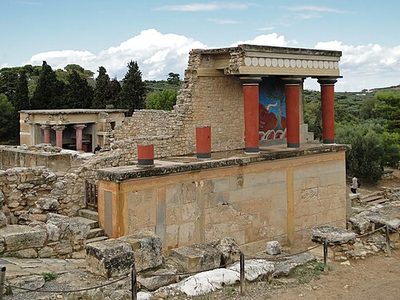
Greek history on this map begins in the Bronze Age Aegean: the Minoan palace at Knossos on Crete (from about 1900 BCE) and the Mycenaean citadels of the mainland, whose palace economies collapsed around 1200 BCE. After a poorly documented period, Greek speakers adapted the Phoenician alphabet around 800 BCE, the Homeric epics took written form, and shared sanctuaries such as Delphi and Olympia gave scattered communities a common religious and athletic calendar.
The defining unit of the Archaic period (c. 800–480 BCE) was the polis, a self-governing city with its farmland. There were hundreds of them, and none ruled the others for long. Greeks founded settlements from the Black Sea to Sicily, southern Italy and the coast of what is now France, usually on land taken from or shared with local peoples. Constitutions varied widely: Sparta combined two kings with a citizen body that lived off the forced labour of the helots, while Athens moved through Solon's reforms (594 BCE) and Cleisthenes' reorganisation (508/507 BCE) towards democracy.
Persia, Athens and Sparta in the Classical age
The Classical period opens with the wars against the Achaemenid Empire: the Ionian revolt, Marathon in 490 BCE and Xerxes' invasion of 480–479 BCE, remembered in Greek sources through Thermopylae, Salamis and Plataea. Athens then led the Delian League, which turned into an Athenian empire whose tribute helped pay for the Parthenon. Rivalry with Sparta led to the Peloponnesian War (431–404 BCE); in its last phase Persian subsidies paid for the Spartan fleet that defeated Athens, and the King's Peace of 387/386 BCE left the Greek cities of Asia under Persian rule.
This was also the age of Herodotus and Thucydides, of Aeschylus, Sophocles and Euripides, of Hippocratic medicine and of Socrates, Plato and Aristotle. Their audiences were male citizens in societies that excluded women from politics and relied on enslaved labour. Greek independence in this sense ended when Philip II of Macedon defeated Athens and Thebes at Chaeronea in 338 BCE; his son Alexander's campaigns opened the Hellenistic era.
Timeline of events
1900 BCE · Minoan Palace Culture Rises at Knossos
Around 1900 BCE the first palace is built at Knossos on Crete, one of several Minoan centres that grouped storage, administration, workshops and ritual space around a central court; whether it was also a royal residence is debated. It is known from excavation, carried out on a large scale by Arthur Evans from 1900 after a trial dig by Minos Kalokairinos in 1878, and from sealings and tablets in Linear A, a script that is still undeciphered, so the Minoans' own language is unknown and is not thought to be Greek. Aegean Bronze Age dates are uncertain by up to a century. (Knossos, Crete) View on map
1600 BCE · Thera Eruption Buries Akrotiri
A massive eruption of the Thera volcano (Santorini) buries the Bronze Age town of Akrotiri under pumice and ash; earlier earthquakes seem to have led its people to leave, and no victims have been found. The ash preserved multi-storey houses and wall paintings that are a main source for Aegean life and art of the period. The date is disputed: radiocarbon results point to about 1630–1530 BCE, while links with Egyptian chronology have suggested about 1530–1500 BCE, and the eruption is no longer thought on its own to have ended Minoan Crete, whose palaces continued for generations. (Akrotiri, Santorini) View on map
1250 BCE · Lion Gate and the Mycenaean Palaces
Around 1250 BCE the citadel of Mycenae in the Argolid is enlarged and given the Lion Gate, whose relief of two lions above the lintel is a rare piece of monumental sculpture from the Bronze Age Aegean. Mycenae was one of several palace centres on the Greek mainland and Crete whose clay tablets in Linear B, deciphered in 1952, record an early form of Greek used to run palace economies. These palace states collapsed around 1200 BCE, during the wider crisis of the eastern Mediterranean. (Mycenae) View on map
800 BCE · Delphi Becomes a Panhellenic Oracle
From about the 8th century BCE offerings accumulate at the sanctuary of Apollo at Delphi, where a priestess, the Pythia, answered questions put by cities and individuals. Cities consulted it before founding colonies, making laws or going to war, and Herodotus reports that non-Greek rulers such as the kings of Lydia sent gifts and questions too; from the early 6th century a league of neighbouring peoples, the Amphictyony, ran the sanctuary. How the oracle actually worked is known mainly from later literary sources and is still debated. (Delphi) View on map
800 BCE · Greeks Adapt the Phoenician Alphabet
Probably in the 8th century BCE, Greeks in contact with Phoenician traders adapt the Phoenician consonant script, turning several signs for sounds that Greek lacked into vowels. The oldest surviving Greek inscriptions, scratched on pottery from the mid-8th century BCE, come from Euboea, Athens and Euboean settlements in Italy such as Pithekoussai; where and when the adaptation happened is disputed. Through these western contacts the Greek alphabet passed to the Etruscans and then to the Romans, whose Latin script descends from it. (Euboea (Eretria)) View on map
776 BCE · First Olympic Games
The first recorded Olympic Games are held at Olympia in Greece, marking a key moment in Greek cultural unity. (Olympia, Greece) View on map
750 BCE · Homeric Epics Take Written Form
The Iliad and the Odyssey, oral epics that the Greeks attributed to Homer, take written form, probably between about 750 and 650 BCE; whether a single poet composed them is debated. They became foundational texts of Greek education and identity and, later, of Western literature. (Ionia (Smyrna)) View on map
667 BCE · Megarian Colonists Found Byzantion
Settlers from Megara found Byzantion on the promontory at the southern mouth of the Bosporus, where Istanbul's historic peninsula now stands. The traditional date of 667 BCE combines Herodotus' statement that it was founded 17 years after Chalcedon across the strait with Eusebius' date for Chalcedon (685/4 BCE), while Eusebius dates it to about 659–656 BCE. It was one of many Greek settlements founded between about 750 and 550 BCE around the Mediterranean and Black Sea, from Syracuse (c. 733 BCE) to Massalia (c. 600 BCE), often on land taken from local peoples. (Byzantion (Istanbul)) View on map
600 BCE · Sappho's Lyric Poetry on Lesbos
Sappho, a poet from Eresos or Mytilene on Lesbos who was active around 630–570 BCE, composes songs to be sung to the lyre, many addressed to women and concerned with love, desire, family and religious festivals. Ancient scholars collected her poems in nine books, but they survive mostly as quotations and papyrus fragments; only the Ode to Aphrodite is certainly complete, and new fragments were published as recently as 2014. Much of her ancient biography, such as the story of her leap from the Leucadian cliff, is later legend. (Mytilene, Lesbos) View on map
594 BCE · Solon's Reforms in Athens
Chosen archon amid conflict between rich and poor, traditionally in 594/3 BCE (some scholars date the reforms to the 570s), Solon cancels debts secured on the debtor's person and bans the enslavement of Athenians for debt, a measure called the 'shaking-off of burdens' (seisachtheia). He divides citizens into four property classes that decide who may hold office and publishes a new written law code. Fragments of his own poems and the later Aristotelian Constitution of the Athenians are the main sources. (Athens) View on map
585 BCE · Thales of Miletus — Birth of Greek Philosophy
Thales of Miletus, considered the first Western philosopher, proposes that natural phenomena can be explained through reason rather than mythology. He reportedly predicts a solar eclipse in 585 BCE, demonstrating the power of systematic observation. His central question — 'What is the world made of?' — launches the Greek philosophical tradition that will define Western intellectual identity. (Miletus, Ionia) View on map
530 BCE · Pythagoras Founds His School
Pythagoras establishes a philosophical and mathematical school in Croton, contributing the Pythagorean theorem and the concept of mathematical harmony. (Croton, Magna Graecia) View on map
508 BCE · Cleisthenes' Reforms and Athenian Democracy
Cleisthenes reorganises the Athenian citizen body into ten new tribes and a Council of 500, laying the foundations of Athenian democracy, in which the assembly of adult male citizens decides public affairs. Women, enslaved people and resident foreigners (metics) are excluded. Other Greek cities also experimented with forms of popular government. (Athens) View on map
480 BCE · Battle of Salamis (Greek Naval Victory)
The Greek fleet, led by Themistocles, decisively defeats the larger Persian navy in the straits of Salamis, turning the tide of the Greco-Persian Wars. (Salamis, Greece) View on map
478 BCE · Delian League Formed Against Persia
In 478/7 BCE, after the defeat of Xerxes' invasion, Athens and many Aegean and Ionian cities form an alliance to continue the war against the Achaemenid Empire, with a common treasury on the sacred island of Delos and contributions paid in ships or money. Athens led it from the start, forced members such as Naxos and Thasos to stay in, moved the treasury to Athens in 454 BCE and spent the tribute on its own aims, so historians speak of an Athenian empire. The main evidence is Thucydides and the Athenian tribute lists inscribed on stone. (Delos) View on map
472 BCE · Aeschylus Stages The Persians in Athens
In 472 BCE Aeschylus, who had himself fought the Persians at Marathon, stages The Persians at the Athenian festival of Dionysus, with the young Pericles paying for the production. Set at the Achaemenid court in Susa, it shows Queen Atossa, a chorus of elders and the ghost of Darius receiving news of Xerxes' defeat at Salamis eight years earlier. Generally regarded as the oldest surviving Greek tragedy, it is an Athenian imagining of Persia, not a Persian source, and scholars debate how far it mourns with its characters or celebrates their defeat. (Theatre of Dionysus, Athens) View on map
441 BCE · Sophocles and Greek Tragedy
Sophocles writes masterpieces like Oedipus Rex and Antigone, elevating Greek tragedy to its highest artistic achievement. (Athens) View on map
432 BCE · Parthenon Completed
The Parthenon temple is completed on the Athenian Acropolis, a masterpiece of Doric architecture and symbol of Athens' golden age. (Athens) View on map
431 BCE · Peloponnesian War Begins
Athens and Sparta begin the devastating Peloponnesian War, a 27-year conflict that reshapes the Greek world and weakens all city-states. (Athens & Sparta) View on map
420 BCE · Hippocrates and the Medicine of Kos
Hippocrates of Kos (c. 460–370 BCE) is associated with a medical tradition that explains disease through natural causes and careful observation rather than divine action. The Hippocratic Corpus was written by several authors over many decades, and the Oath that bears his name is still invoked in medical ethics. (Kos, Greece) View on map
411 BCE · Thucydides Writes History of the Peloponnesian War
Thucydides writes his rigorous, evidence-based account of the Peloponnesian War, pioneering the scientific approach to historiography. (Athens) View on map
399 BCE · Trial and Death of Socrates
Socrates is tried and executed in Athens for impiety and corrupting youth, becoming a foundational figure of Western philosophy. (Athens) View on map
387 BCE · Plato Founds the Academy
Plato establishes the Academy in Athens, one of the first institutions of higher learning in the Western world. (Athens) View on map
338 BCE · Philip II Defeats Athens and Thebes at Chaeronea
In 338 BCE, probably in August, the Macedonian army of Philip II, with his son Alexander commanding one wing, defeats the allied forces of Athens and Thebes at Chaeronea in Boeotia. The battle ended the leading city-states' ability to resist Macedon: in 337 BCE Philip gathered most Greek states into the League of Corinth under his leadership and announced a war against the Achaemenid Empire. The Lion of Chaeronea, a monument still standing at the site, is thought to mark the grave of the Theban Sacred Band. (Chaeronea, Boeotia) View on map
335 BCE · Aristotle Founds the Lyceum
Aristotle establishes his school, the Lyceum, in Athens, making groundbreaking contributions to logic, biology, ethics, and political science. (Athens) View on map
333 BCE · Battle of Issus: Alexander vs Darius III
Alexander the Great defeats Darius III at Issus, a decisive battle that opens the door to the conquest of the Persian Empire. (Issus, Cilicia) View on map
332 BCE · Alexander Conquers Egypt
Alexander the Great conquers Egypt and founds the city of Alexandria, which becomes a major center of Hellenistic culture and learning. (Alexandria, Egypt) View on map
331 BCE · Battle of Gaugamela: Fall of Persia
Alexander decisively defeats Darius III at Gaugamela, effectively ending the Achaemenid Empire and beginning Hellenistic rule over Persia. (Gaugamela, Mesopotamia) View on map
323 BCE · Alexander Dies in Babylon
Alexander III of Macedon dies in Babylon in June 323 BCE, aged 32, a date fixed by a Babylonian astronomical diary that records simply that 'the king died'. He had ruled most of the former Achaemenid Empire since 330 BCE and left no adult heir; the cause of his death, illness or, as some ancient writers claimed, poison, is still debated. His generals divided the empire in decades of war, from which the Ptolemaic, Seleucid and Antigonid kingdoms emerged. (Babylon) View on map
250 BCE · Archimedes of Syracuse: Mathematics and Engineering
Archimedes of Syracuse makes major advances in mathematics, mechanics and engineering, including the principle of buoyancy, the law of the lever and methods for measuring areas and volumes; the water screw that bears his name is traditionally credited to him. He is killed when Rome captures Syracuse, c. 212 BCE. (Syracuse, Sicily) View on map
Frequently asked questions
What is the difference between Archaic and Classical Greece?
They are modern labels. The Archaic period (c. 800–480 BCE) covers the rise of the city-states, colonisation and the alphabet; the Classical period (480–323 BCE) runs from Xerxes' invasion to the death of Alexander and includes the Athenian empire, the Peloponnesian War and the great age of Athenian drama and philosophy.
Was ancient Greece one country?
No. Greeks shared a language, gods, festivals and the Homeric poems, but they lived in hundreds of independent city-states that often fought each other. Unity came only under outside or hegemonic power: Macedon in the fourth century BCE and later Rome.
Key events on the map
- 1900 BCE · Minoan Palace Culture Rises at Knossos
- 750 BCE · Homeric Epics Take Written Form
- 594 BCE · Solon's Reforms in Athens
- 508 BCE · Cleisthenes' Reforms and Athenian Democracy
- 480 BCE · Battle of Salamis (Greek Naval Victory)
- 431 BCE · Peloponnesian War Begins
- 399 BCE · Trial and Death of Socrates
- 338 BCE · Philip II Defeats Athens and Thebes at Chaeronea
Guided storylines
- Ancient Greek civilization — Encyclopaedia Britannica
- democracy, Athenian — Oxford Classical Dictionary
- Battle of Chaeronea — Encyclopaedia Britannica